
مرحباً بكم في جي إم تك
مرحباً بكم في جي إم تك
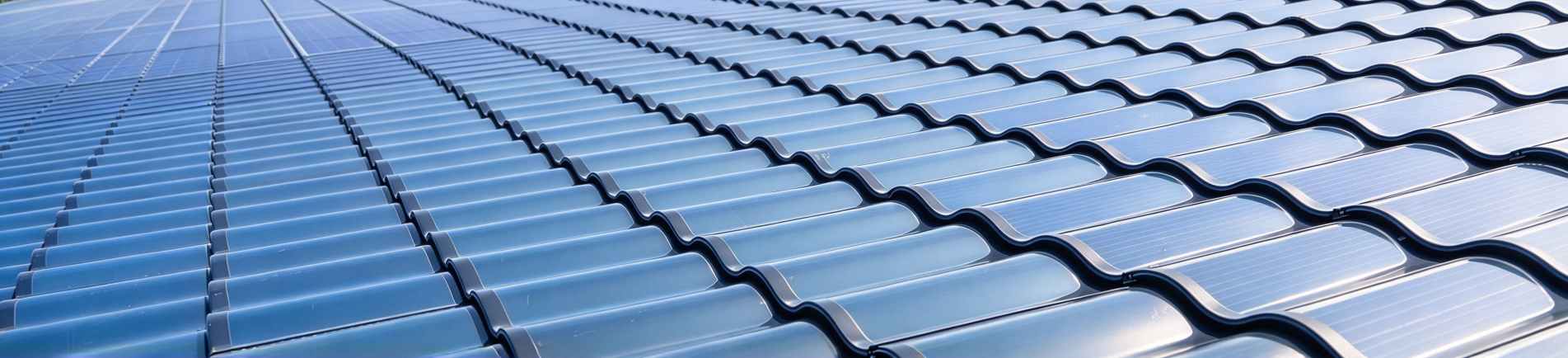
Thin-film three-curve solar tiles are one of the most architecturally integrated BIPV options on the market. Their curved CIGS (copper indium gallium selenide) layer, ETFE front film and laminated edge sealing let them replace conventional roof tiles while generating electricity. That multi-layer build is exactly what makes them attractive — and what introduces a specific failure mode that project teams should understand: ETFE surface delamination, commonly described on site as "peeling" or "lifting."
This article explains what that failure looks like, how the multi-layer structure works, the root causes across manufacturing, installation and climate, the real risks it creates, and the checks that catch it before it becomes a roof problem.
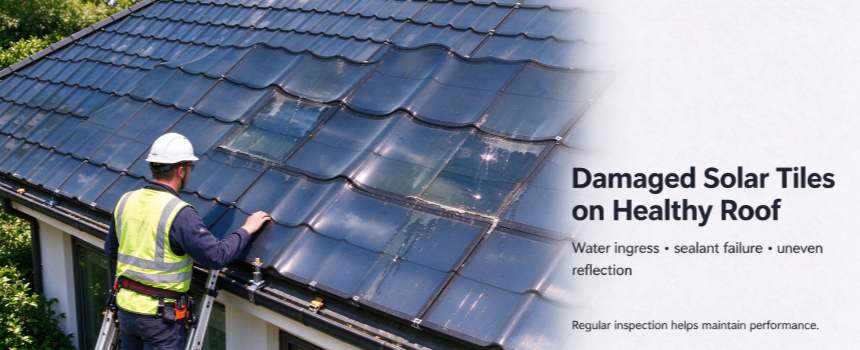
Fig 1 — ETFE surface delamination (peeling) on a curved CIGS solar tile. Replace with site photo.
A curved solar tile is not a flat panel bent into shape. It is a laminated composite built from the outside in:
The curved profile adds a permanent bending stress that flat panels do not carry. ETFE is chemically inert by nature, which is a good thing for durability, but it also means the surface must be specially treated (corona, plasma or primer) before the encapsulant will bond to it reliably. If that surface treatment is inconsistent, the interface between ETFE and encapsulant becomes the weakest link in the stack.
A simple way to picture the failure: imagine a multi-layer sticker on a curved surface. If the adhesive at the edge starts to lift, moisture and air get under the layers, and the lifting spreads. In a solar tile, that "lifting" is delamination.
Delamination has a recognizable appearance that differs from common surface defects. The main visual signs are:
These signs are distinct from other common issues:
| Issue | How it differs from delamination |
|---|---|
| Surface dirt or bird droppings | Washes off; does not affect film adhesion |
| Scratches or abrasion | Linear marks on the ETFE surface, no separation |
| Hail damage | Localized puncture or crack, usually with a clear impact point |
| Hot-spot yellowing | Discoloration of the cell layer, no film lifting |
Visual inspection is the first step. Where delamination is suspected, two lab tests give a clearer picture:
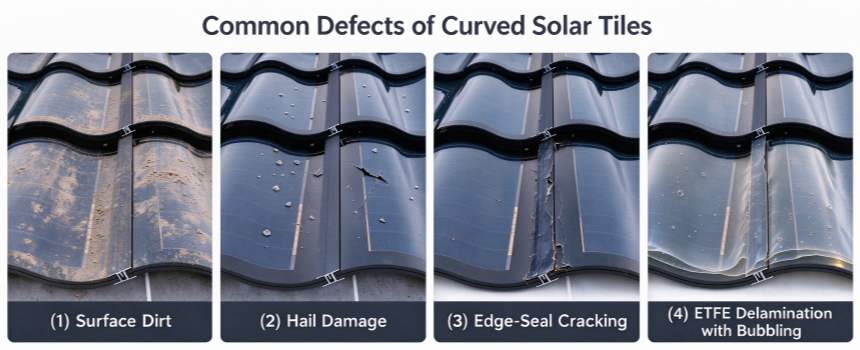
Fig 2 — Side-by-side comparison: (1) surface dirt, (2) hail damage, (3) edge-seal cracking, (4) ETFE delamination with bubbling. Replace with field inspection photos.
Delamination is rarely a single-cause event. It is a chain of conditions that, once started, tends to accelerate. The typical sequence runs like this.
The side seal is the first barrier against moisture. If it degrades, cracks, or is mechanically damaged during installation, rain and humidity can enter the tile interior along the edge.
Once water reaches the ETFE–encapsulant interface, it begins to hydrolyze the adhesive bond. Encapsulants are designed to be moisture-resistant, not moisture-proof at a compromised edge. The bond weakens progressively rather than failing all at once.
Once the seal is breached, three categories of factor determine how quickly and how far delamination spreads.
A single impact event — hail, a falling branch, dropped tools during maintenance — can create a small breach in the ETFE or edge seal. If the breach is not detected and sealed, it becomes a new entry point for moisture, and the delamination process begins from that point.
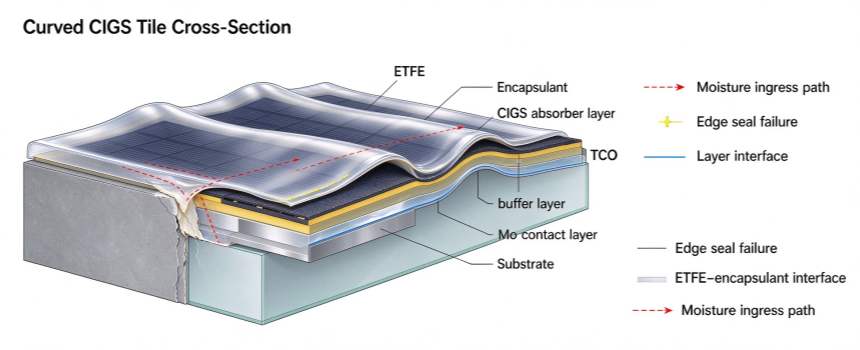
Fig 3 — Annotated cross-section of a curved CIGS tile showing moisture ingress path from a compromised edge seal through the ETFE–encapsulant interface. Replace with technical diagram.
The consequences are not cosmetic. Once the ETFE begins to separate from the underlying layers, three things happen in parallel.
The delaminated zone no longer transmits light cleanly to the CIGS cell. Output from that area drops. If moisture reaches the cell layer itself, it can corrode the thin-film electrodes, causing a progressive and irreversible power loss that extends beyond the visibly affected area.
Moisture inside the tile reduces insulation resistance. In a string of tiles at system voltage, reduced insulation can lead to leakage current to ground or, in the worst case, DC arcing at a damaged interconnect. Both conditions are safety issues, not just performance issues.
The tile is simultaneously a power generator and a roof covering. A failing edge seal means the tile is also failing as a waterproofing element. Water that enters through a delaminated edge can migrate into the roof structure, with consequences for insulation, battens and the building interior.
A delaminated tile cannot be reliably repaired on the roof. The multi-layer bond cannot be restored in situ. The correct response is replacement of the affected tile(s) and investigation of why the failure started, so the same issue does not recur across the installation.
Prevention is a combination of product selection, design, installation discipline and ongoing inspection.
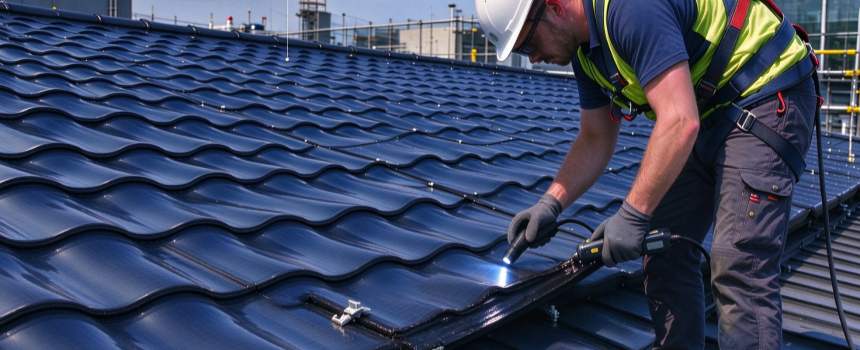
Fig 4 — Installer inspecting edge seals on a completed curved solar tile roof. Replace with project site photo.
When delamination is reported or suspected on a project, the following steps help separate a single-event damage case from a systemic issue.
ETFE delamination on a curved CIGS solar tile is a multi-layer adhesion failure. It typically starts with a compromised edge seal that allows moisture to reach the ETFE–encapsulant interface. Thermal cycling, UV aging, and installation stress accelerate the process. The result is declining power output, reduced electrical insulation, and compromised roof waterproofing.
BIPV is not just a solar product — it is a building component. The tile must perform as a roof covering and as a power generator for decades. That means the materials, the manufacturing process, the roof design, and the installation all have to be right. There is no single point of failure that explains every case, and there is no single fix that covers every symptom.
GreenMore has worked on BIPV thin-film tile projects across Europe, the Middle East and Asia, including the curved triple-arch hantile range. Our role as the tile manufacturer is to support project teams from the early feasibility stage — reviewing roof design, confirming product suitability, and providing technical guidance through installation and commissioning — rather than only supplying a product and walking away. For partners planning a curved solar tile roof, we can review the roof layout, confirm the tile model and configuration, and provide a project-specific proposal. Reach us through our contact page or at export@gmsolarkit.com.
Partially, yes. The undamaged areas of the tile will continue to produce power. But the delaminated zone no longer contributes, and moisture ingress can progressively corrode the cell layer. A delaminated tile should be replaced rather than left in service, both for performance and for electrical safety.
No. The multi-layer bond cannot be restored in situ. Attempting to re-seal or re-laminate a delaminated tile on the roof does not restore the original adhesion or insulation properties. The correct action is tile replacement.
High-humidity coastal regions, areas with large day–night temperature swings (desert climates), and regions with freeze–thaw cycles all accelerate the conditions that lead to delamination. Projects in these climates should place extra emphasis on edge-seal material selection, overlap drainage design, and post-installation inspection.
Updated October 14, 2026
External references: IEC 61215 (crystalline and thin-film module qualification), IEC 61730 (PV module safety qualification), EN 14782 (self-supporting metal sheet for roofing).
يرجى مواصلة القراءة، والبقاء على اطلاع، والاشتراك، ونحن نرحب بك لتخبرنا بما تفكر فيه.




حقوق الطبع والنشر
@ 2026 جي إم تك جميع الحقوق محفوظة
.  الشبكة المدعومة
خريطة الموقع / مدونة / Xml / سياسة الخصوصية


