
مرحباً بكم في جي إم تك
مرحباً بكم في جي إم تك
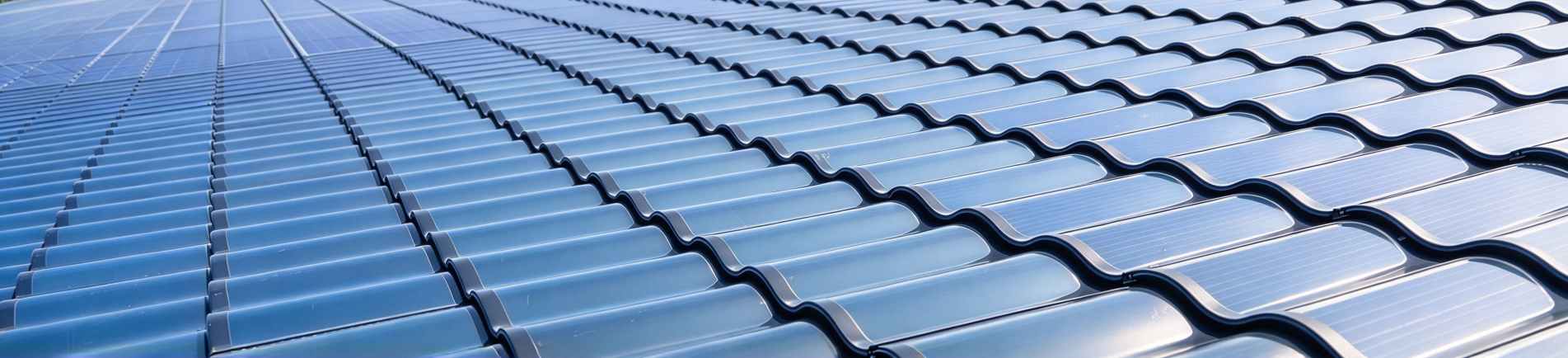
A solar tile quotation arrives with a folder of PDFs: EN 14782, IEC 61215, IEC 61730, CE, ISO 9001. It looks thorough, and most buyers stop there. The real question is not how many certificates a supplier has, but what each one proves — because two of them are routinely confused.
IEC 61215 and EN 14782 come from different worlds. One governs whether the thing generates electricity, the other whether it can legally sit on a roof. A tile can pass one and fail the other.
IEC 61215 is a module standard. It asks whether this laminate still delivers its rated power after twenty-five years of sun, frost, humidity and wind. It comes from IEC Technical Committee 82, the same group behind the rest of the photovoltaic standards family.
EN 14782 is a construction product standard. Its full title is Self-supporting metal sheet for roofing, external cladding and internal lining — Product specification and requirements. It asks whether this panel works as a building envelope: can it carry load, shed water, resist uplift, survive corrosion?
Neither substitutes for the other. A BIPV roof sits in both systems at once, which is why its documentation has to be assembled on two separate tracks.
| Standard | What it governs | Where it is used |
|---|---|---|
| IEC 61215 | Design qualification of the module — power retention under environmental stress | Datasheets, bankability review, EPC procurement |
| IEC 61730 | Module safety — electric shock, fire and mechanical hazards | Insurance, grid connection, safety file |
| EN 14782 | Self-supporting metal roofing — load capacity, watertightness, uplift resistance | Building permit, CE marking, Declaration of Performance |
| EN 1090-1 | Execution of steel and aluminium structures — factory production control | Fixing systems, mounting rails |
The current edition runs a module through a fixed sequence, and the sequence matters as much as the individual tests.
Pass criteria are set in terms of degradation: no more than 5% loss of maximum power, insulation resistance within limits, no major visual defect, no open circuit or ground fault.
What it does not do is the part buyers miss. The specimen is a laminate clamped into a test frame. It is not mounted on a roof, it has no overlap with the tile above, no fixing clip, no battens underneath. Those are the components that decide whether a roof leaks.
So a 5,400 Pa pass means the laminate survives 5,400 Pa of uniform pressure. It does not mean the assembled roof resists 5,400 Pa of wind uplift, which depends on batten span, clip spacing, substrate stiffness and course interlock — a structural calculation, not a laboratory one. IEC 61215 also contains no watertightness test: a laminate can pass the full sequence and still leak through a badly designed side lap.
EN 14782 covers factory-made, self-supporting metal sheets and tiles for non-structural roofing and cladding. It sets terminology, material requirements, dimensional tolerances, load capacity, watertightness and uplift resistance, plus the test methods behind each.
Compliance is documented through a Declaration of Performance issued by the manufacturer, which is what allows the CE mark under the Construction Products Regulation. For a BIPV tile, this is the document that gets a product onto a roof legally in the EU — not the module certificate.
The limit is obvious once stated: EN 14782 says nothing about electricity. A panel fully compliant with it can generate precisely zero watts. Fire classification is also outside this standard — that sits in EN 13501-1, which is why the Class C rating on a solar tile is a separate line in the file.
| What the buyer assumes | What it actually proves | What is still missing |
|---|---|---|
| "It has IEC 61215, so we can sell it as a roof covering" | Power retention and durability of the laminate | EN 14782 and a Declaration of Performance |
| "It has EN 14782, so we can bid the PV package" | Performance as a roofing component | IEC 61730 and local grid compliance |
| "It carries CE, so it passed a certification" | The manufacturer declares conformity | Third-party test evidence |
The third is the most widespread. CE marking means the manufacturer takes responsibility for conformity and holds the technical file behind it; only certain higher-risk categories need a notified body.
To be specific rather than impressive: we hold EN 14782, EN 1090-1, IEC 61215, IEC 61730 and CE, alongside ISO 9001 and ISO 14001. Certificate scans travel with the quotation, and every number can be checked against the issuing body's register.
What we will not do is claim the whole catalogue is covered by one document. For a European project, prepare the roofing file against EN 14782 and the electrical file against IEC 61215 and IEC 61730.
IEC 61215 proves a solar tile can generate. EN 14782 proves it can sit on a roof. A BIPV project needs both, and a supplier who can only produce one is telling you which half of the product they control.
No. IEC 61215 contains no watertightness test. It evaluates power retention and safety after environmental stress on a clamped laminate. Waterproofing belongs to the assembled roof system — overlap geometry, drainage path and flashings — and is addressed under construction product standards such as EN 14782.
As a construction product placed on the market for roofing, it needs a harmonised route and a Declaration of Performance to carry the CE mark under the Construction Products Regulation. Without that it can still be sold as an electrical component, but not presented as a roof covering.
IEC 61215 is about performance and durability — whether the module keeps producing after years of stress. IEC 61730 is about safety — construction requirements that prevent electric shock, fire and mechanical injury. A module normally needs both before installation on a building.
There is no single answer, because a BIPV roof is assessed twice — once as a building envelope, once as an electrical installation. The roofing consultant asks for EN 14782 and the fire classification; the electrical consultant asks for IEC 61215 and IEC 61730.
Updated October 30, 2026
External references: IEC 61215-1 (design qualification and type approval of PV modules), IEC 61730-1 (PV module safety qualification), BS EN 14782 (self-supporting metal sheet for roofing), CE marking (European Commission).
يرجى مواصلة القراءة، والبقاء على اطلاع، والاشتراك، ونحن نرحب بك لتخبرنا بما تفكر فيه.




حقوق الطبع والنشر
@ 2026 جي إم تك جميع الحقوق محفوظة
.  الشبكة المدعومة
خريطة الموقع / مدونة / Xml / سياسة الخصوصية


