
مرحباً بكم في جي إم تك
مرحباً بكم في جي إم تك
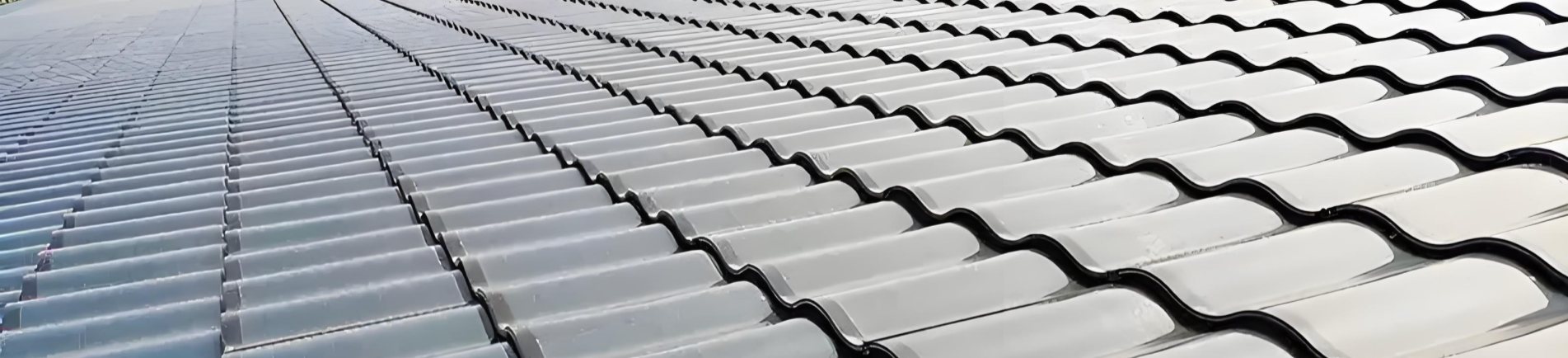
GreenMore's tiled type photovoltaic tiles are rated for a maximum static mechanical load of 5,400 Pa on the front side and 2,400 Pa on the back side. For context, the IEC 61215-2 standard (the international qualification test for terrestrial PV modules) specifies 3,600 Pa as the mechanical load test threshold. GreenMore's tiles exceed that baseline by 50% on the front face.
These numbers matter because a BIPV roof tile doesn't sit on top of a roof — it is the roof. Unlike rack-mounted panels where a separate structure absorbs wind and snow loads, the tile itself must carry the full mechanical stress and transfer it to the building structure through its mounting points.
Pressure in Pascals can feel abstract. Here's what it translates to on the ground:
| Load Scenario | Approximate Pressure | Context |
| Category 2 hurricane (154–177 km/h winds) | 2,500–3,500 Pa | Front-side load on roof surface |
| Heavy wet snow accumulation (60 cm depth) | 2,400–3,000 Pa | Downward load on tilted roof |
| IEC 61215-2 standard test | 3,600 Pa | Uniform static load qualification |
| GreenMore front-side rating | 5,400 Pa | 50% above IEC baseline |
| GreenMore back-side rating | 2,400 Pa | Uplift resistance |
In high-wind regions, the ASCE 7-22 building standard (used across the United States) defines ultimate wind speeds (Vult) that vary dramatically by location. Coastal Florida faces Vult values up to 170 mph (76 m/s), while inland cities like Chicago sit around 105 mph (47 m/s). The wind pressure on a roof surface scales with the square of wind speed — which means a roof in Miami faces roughly 2.7× the wind pressure of the same roof in Chicago.
The 5,400 Pa front-side rating covers most extreme wind scenarios encountered in residential and commercial rooftop installations. The 2,400 Pa back-side rating addresses negative pressure (uplift) during severe storms, where wind flowing over the roof ridge creates suction forces that try to pull the covering off the deck.
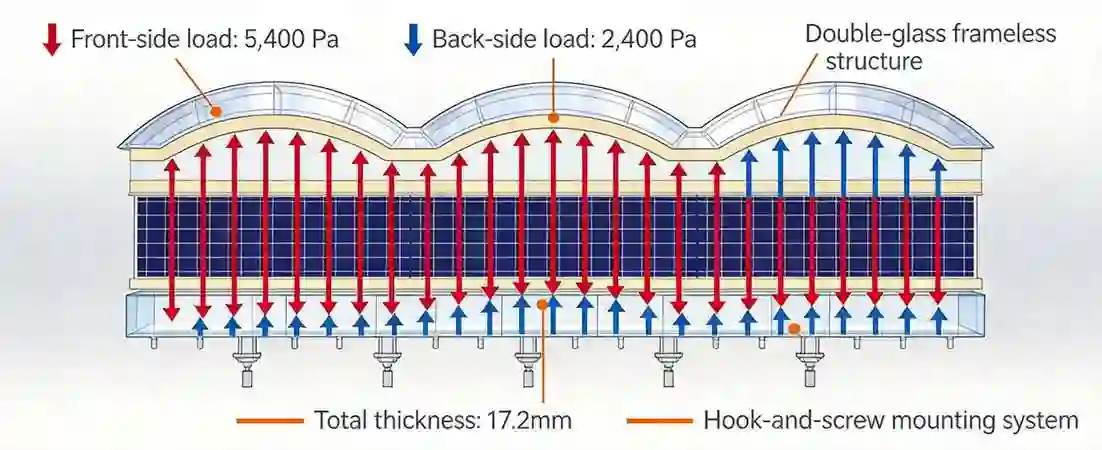 GreenMore Triple-Curve Double-Glass Photovoltaic Tile Load Structure Analysis Diagram
Conventional solar modules use an aluminum frame that provides structural rigidity around the perimeter. Remove the frame — as in GreenMore's frameless design — and the glass itself has to do all the work. This sounds like a liability. It's actually an advantage, once you understand the mechanics.
A framed module distributes load to its four edges, where the frame transfers stress to the mounting clamps. If the frame deforms — from corrosion, thermal expansion mismatch, or impact damage — the load distribution changes and cells become vulnerable to microcracking. The frame becomes a single point of failure.
A double-glass frameless tile spreads the load across the entire surface area. The symmetrical glass-glass sandwich creates a monolithic structural panel that resists bending in both directions. Under frontal load (wind pushing down, snow pressing from above), the two glass layers share the stress through the encapsulant bonding layer. Under back-side load (wind uplift suction), the same monolithic structure resists deflection uniformly.
The IEC 61215-2:2021 standard's mechanical load test (MQT 16) applies uniform static pressure to the module surface for one hour. The 2021 edition also added a cyclic dynamic mechanical load test (MQT 20) that subjects modules to 1,000 cycles of positive and negative pressure — simulating the repeated gusting and lulling of real wind events. GreenMore's tiles are designed to pass both test protocols at their rated load levels.
Snow doesn't pile up evenly on a roof. In real-world conditions, snow slides down the panel surface and accumulates at the lower edge, creating a non-uniform load that puts concentrated stress on the bottom portion of the module. This is a well-documented failure mode in mountain installations.
In 2020, the IEC published IEC 62938, a dedicated standard for testing PV module resistance to non-uniform snow loads. The standard simulates the real failure type: modules bending and cracking at the lower edge of sloped installations where snow accumulates unevenly.
GreenMore's 5,400 Pa front-side rating addresses this scenario. The large tile format (1378mm × 564.8mm) means fewer horizontal joints where snow can dam up, and the double-glass structure distributes concentrated edge loads across the full panel area rather than letting them concentrate at a single frame corner.
For regions with heavy snowfall — Northern Europe, Canada, the northeastern United States, and high-altitude zones in Asia — the non-uniform snow load rating is often the governing design constraint, not wind speed.
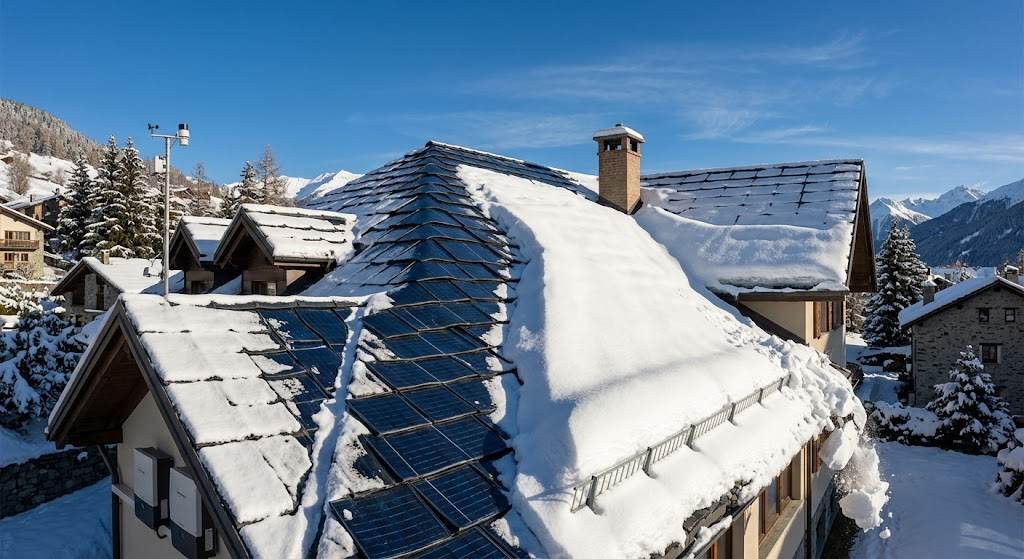 Demonstrates the uneven load of snow accumulation on the roof
Mechanical load testing typically focuses on static pressure. But roofs also face impact events — hail, falling branches, construction debris, and occasionally maintenance foot traffic.
The double-glass tempered structure provides inherent impact resistance. Tempered glass is 4–5 times stronger than annealed glass of the same thickness. When it does break (under extreme impact beyond design limits), it fractures into small, relatively blunt pieces rather than sharp shards — reducing injury risk.
For BIPV tiles specifically, the impact resistance matters in another way. Because the tile is the roof covering, any impact damage that compromises the glass surface also compromises the waterproofing layer. This is different from a rack-mounted panel, where a cracked front glass surface affects power output but doesn't let water into the building. The double-glass design — with cells protected on both faces — provides a more robust impact buffer than a single-glass module with a soft polymer back.
The 17.2mm total thickness — two layers of tempered glass plus encapsulant and cells — provides the structural depth needed to achieve these load ratings without an aluminum frame.
The mechanical load rating is just one input to the system design. Installers working in high-wind or high-snow regions need to consider the full load path — from the tile surface through the mounting system to the roof structure and finally to the building frame.
GreenMore's hook-and-screw mounting system transfers loads from each tile through mechanical fasteners directly into the roof purlins or decking. The large tile format means each mounting point carries load from a larger area, but the total number of mounting points is lower than with smaller-format tiles. For engineering verification, GreenMore provides structural calculations and load tables to support permitting in different climate zones.
For specific project inquiries — including load calculations for high-wind coastal sites or heavy-snow mountain installations — GreenMore's engineering team provides technical support through the contact page.
The 5,400 Pa / 2,400 Pa mechanical load rating puts GreenMore's tiled type photovoltaic tiles well above the IEC 61215 qualification baseline. The double-glass frameless structure distributes stress uniformly, eliminates frame-related failure points, and provides the structural rigidity needed for a tile that serves as both the weather barrier and the power generator. For buildings in regions where extreme weather is not a theoretical risk but an annual reality, that structural margin is what keeps the roof intact and the power on.
يرجى مواصلة القراءة، والبقاء على اطلاع، والاشتراك، ونحن نرحب بك لتخبرنا بما تفكر فيه.




حقوق الطبع والنشر
@ 2026 جي إم تك جميع الحقوق محفوظة
.  الشبكة المدعومة
خريطة الموقع / مدونة / Xml / سياسة الخصوصية


